Before the Album: How Sheet Music Carried Songs Between Homes
Before recorded albums became familiar, sheet music helped songs travel between homes, offering a practical way to learn, share, and reshape them.
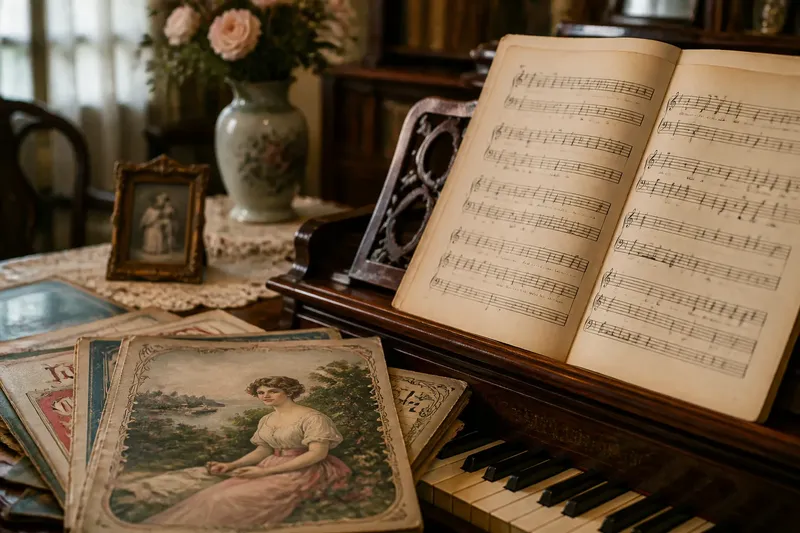
The common mistake is to treat sheet music as a poor substitute for a recording. In parts of Europe and North America during the nineteenth and early twentieth centuries, printed songs were one route by which music travelled between homes; they asked players and singers to make the sound themselves. That work also gave a printed song room to change.
Sheet music moved through shops, publishers, theaters, schools, and family parlors. Its pages carried notes and lyrics, along with clues about how a song might be performed, who might buy it, and what people could do with it at the piano. The page was both a musical object and an invitation to perform.
Portable performances
A printed song could travel farther than the performer who first sang it. A household with a piano and a reader who knew the notation could turn the page into an event: someone played the accompaniment, another sang, and listeners supplied the rest. The music was not stored in the paper. The paper helped people recreate it.
A melody could be learned in one place and performed in another, without the original singer present. The tune might reach a town before a touring performer did. A familiar lyric could be recognized even when the tempo, vocal range, or keyboard style differed from the version that first caught attention.
Say a family receives a song printed for voice and piano. One person reads the melody while another works through the chords; if the singer finds the written key uncomfortable, they choose a more suitable one. The expected result is a recognizable song shaped to the people and instrument in that room, not a duplicate of one authoritative performance.
The page carried instructions, not a finished sound.
Household instruments
Sheet music depended on access to an instrument, and the piano became a familiar center of domestic music-making in many settings. Playing and singing at home offered a way to spend an evening, teach a child, entertain visitors, or take part in a social custom. Printed songs gave those gatherings fresh material.
That relationship worked in both directions. A song could encourage a household to acquire or use a piano, while an audience of players gave publishers a reason to issue more songs. The sheet was repertoire and a promise of an activity: buy the page, then gather people around the instrument.
The arrangement mattered. A manageable accompaniment could suit an amateur player, while a demanding piano part might appeal to a more skilled musician. Publishers could offer the same musical idea in formats aimed at different abilities. A household did not need to reproduce a concert arrangement; it needed a version someone could play.
Read the accompaniment as a clue to the intended room, not just as background.
Publisher choices
Song circulation was also a business. Publishers selected material, prepared editions, promoted titles, and tried to persuade buyers that a particular song belonged in their homes. Cover art, typography, titles, lyrics, and the publisher’s name helped a page attract attention before anyone played a note.
A sheet could present a song as comic, sentimental, patriotic, romantic, or suited to a particular occasion. Such labels guided expectations and helped a buyer decide whether the song fit the people likely to gather around the piano. The printed object was both a score and an advertisement.
Publishing shaped what circulated, but it did not dictate what every player heard. An edition might preserve a melody while leaving room for variation in phrasing, accompaniment, and vocal delivery. Publishers helped spread a song’s identity; performers supplied its particular sound.
A title page can suggest who the publisher hoped would bring the song home.
Choices in notation
Written music specifies some things clearly and others less completely. Notes and rhythms indicate a musical outline; words such as “slowly” or “lively,” where present, offer broad direction. A page cannot capture every nuance of timing, tone, emphasis, or expression. Even detailed notation leaves performers with decisions.
That openness was not a flaw that later technology corrected. It was part of how music worked in the room. A pianist might delay a phrase, soften an accompaniment, or simplify a difficult passage. A singer could alter the delivery to suit their voice. Listeners heard the choices made by the people present, rather than one fixed version replayed identically.
Different editions could also change what a player encountered. Arrangements might alter the key, accompaniment, or difficulty. Lyrics and musical details could vary between printings. When comparing copies, distinguish the song as a recognizable idea from the particular arrangement on the page.
Printed music offered a shared outline, not one final interpretation.
Social settings
A song could move among public and private settings. It might be heard in a theater or entertainment venue, then bought in print and played at home. It could pass from a music teacher to a pupil, from one household to another, or from a player who knew the tune to someone learning it from notation. Each setting changed the scale and character of the performance.
In a public venue, performers could project a song to a crowd and make it memorable through voice, gesture, and dramatic context. At home, the same material could become quieter and more participatory. A relative might sing instead of a professional, while listeners joined in, commented, or took a turn at the keyboard.
That movement complicates the idea of a song as a fixed object. A printed version connected different people without making their performances identical. Continuity came from recognizable musical and verbal features; differences came from the rooms, skills, and purposes shaping each performance.
Follow a song between settings, and its changes become part of its history.
Reading the evidence
When examining historical sheet music, start with what is visible. The cover may name a publisher or advertise a mood. The score shows the forces expected: solo voice, piano, or another combination. Lyrics reveal subject and tone, while the arrangement suggests what kind of player the edition addresses.
Then separate evidence from inference. A song arranged for voice and piano was usable in a home with those resources, but that alone does not establish how often it was performed or who owned a copy. A decorative cover suggests an effort to attract buyers; it does not tell you how the page was received. The object gives clues, not a complete record of every performance.
Imagine finding a printed song with a clear vocal line, a compact piano part, and lyrics suited to group singing. You can infer that the edition could support an informal household performance. You cannot conclude from the page alone that a particular family sang it, or that every performance followed the notation closely.
That distinction keeps the material evidence useful without asking it to say more than it can.
Sheet music questions?
How did songs spread before recordings?
In many settings, printed editions could be sold, carried, taught, and shared, allowing performers to learn a song away from its original venue. Singing and playing then gave the page sound in each new place.
Could a household change a printed song?
Yes. Players could adjust tempo, phrasing, accompaniment, or key to suit their abilities and instruments. The printed arrangement guided performance without containing every expressive choice.
Was sheet music only for piano players?
No. Editions could include vocal lines, lyrics, and arrangements for different combinations of performers. The piano was prominent in domestic music-making, but singing and other musical settings also helped songs circulate.
What does old sheet music tell us?
It can show how a song was arranged, presented, and marketed, as well as the performers and instruments an edition addressed. It cannot, by itself, establish exactly who played it or how any particular performance sounded.
Pages and performance
Before recorded albums became a familiar way to encounter music, sheet music connected a song to people willing to perform it. The page could carry a melody across distance, invite a household into the work of making music, and leave room for each performance to reflect its setting. That made sheet music a means of organizing how sound travelled, not simply a silent stand-in for sound.
When you encounter a printed song, read both the music and the object around it. The notes show one route into performance; the cover, arrangement, and lyrics hint at the people the publisher hoped would take that route. Before albums became common, a song’s journey could begin when someone opened the page and sat down to play.